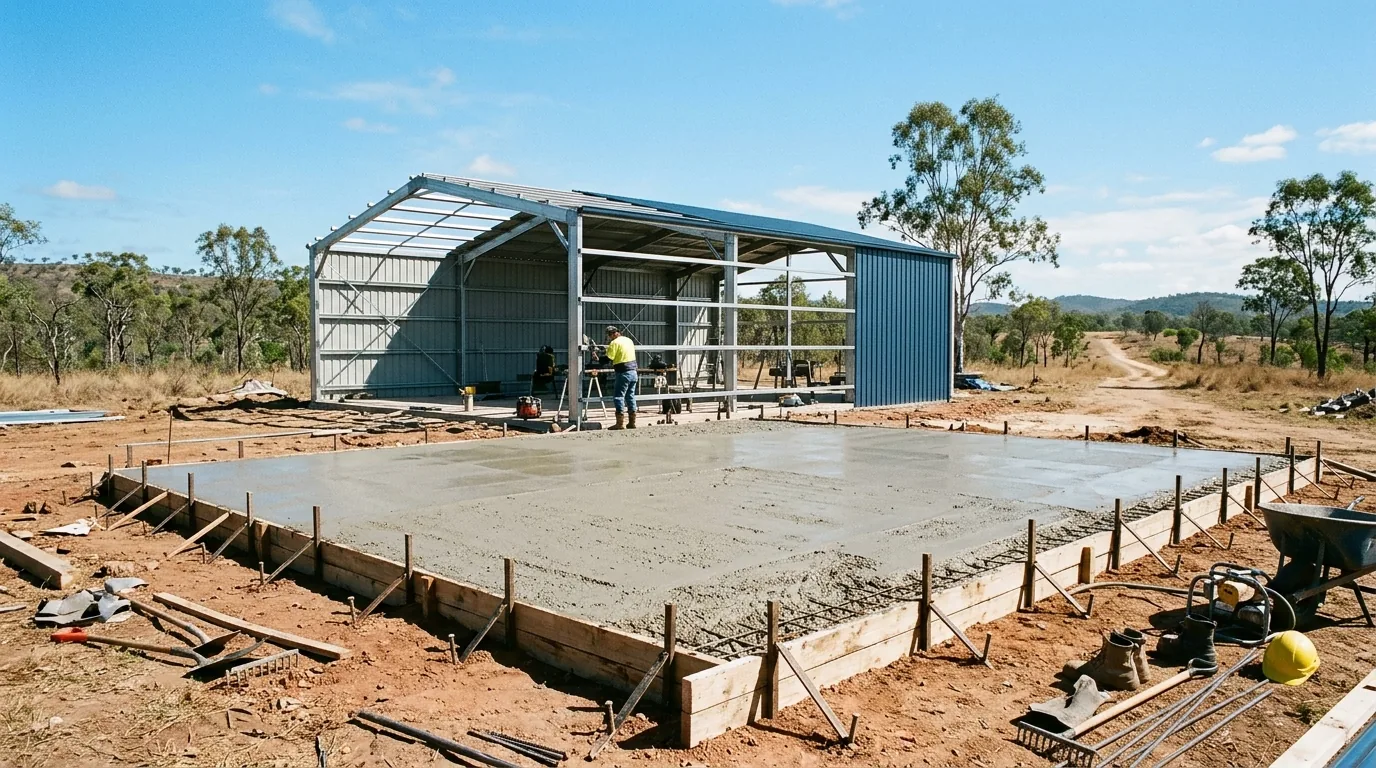
Putting up a shed is one of the most popular jobs we get asked about across Rockhampton, Gracemere and the Capricorn Coast — and the slab underneath it matters far more than most people expect. Get the slab right and your shed stands dead level for decades. Get it wrong and you’re chasing cracks, sticking doors and water pooling where it shouldn’t.
The first question is always the same: what does a shed slab cost? The honest answer is that it depends on a handful of things, but once you understand them you can budget properly and read a quote with confidence. Here’s how shed slab pricing works in Central Queensland.
What affects the price of a shed slab
Size
The biggest single factor is simply how many square metres you’re pouring. A small 3x3 garden shed slab is a quick job; a 9x12 farm shed or a four-bay machinery shed is a different scale of concrete, steel and labour. Per-square-metre rates usually come down a little on bigger pours, but the total obviously climbs.
Thickness and reinforcement
A standard shed slab is typically around 100mm thick with steel mesh through it. Once you’re storing heavy gear — tractors, trucks, a hoist, a boat on a tandem trailer — you move up to 125–150mm with heavier reinforcement, and that means more concrete and more steel.
Site preparation
This is the part you never see but it makes or breaks both the price and the slab. Excavation, removing topsoil, building up and compacting road base, and getting the levels right all take time. On a sloping block you may need cut-and-fill or a retaining edge. Skimping on prep is the number one reason slabs crack early.
Access
Can the concrete truck and pump get close, or does it all have to be barrowed or pumped a long way? Tight suburban blocks in Rockhampton and long rural driveways out past Gracemere both add cost in their own way.
Rural blocks
Out-of-town jobs often mean travel, trickier access, softer or reactive soils and sometimes no nearby water or power. None of that is a dealbreaker — we do plenty of rural slabs — but it’s worth factoring in.
Thickened-edge vs standard slab
Most shed slabs are poured as a “thickened-edge” slab — a flat slab with a deeper, beefed-up perimeter beam that carries the weight of the shed walls and gives the frame something solid to bolt down to. It’s the standard approach for kit sheds and what most shed suppliers specify.
A plain flat slab of even thickness is cheaper but generally only suits very light structures or non-structural pads. For anything you’re bolting a steel frame to, the thickened edge is the right call — and often a requirement of the shed engineering.
Engineering for bigger sheds
Small garden sheds rarely need much. But once a shed gets larger, taller, or is going to be habitable or used for heavy storage, you’ll usually need an engineered slab design with a certificate, and council approval. The engineer specifies slab thickness, edge beams, footing depths and reinforcement based on your soil and wind region — and Central Queensland is a high-wind area, so the tie-down detail matters.
We work to whatever the engineer and your shed supplier specify, and we’ll tell you up front if your job is likely to need engineering so there are no surprises.
Indicative shed slab cost ranges
As a rough guide for Central Queensland, here’s how the per-square-metre price tends to scale with the build-up:
| Slab type | Indicative range (per m²) |
|---|---|
| Light garden shed pad (100mm, mesh) | $ — most affordable |
| Standard kit shed slab (100mm, thickened edge) | $$ — typical |
| Heavy-duty slab (125–150mm, heavier steel) | $$$ — premium |
| Engineered slab (cert + council, reactive soil) | $$$+ — varies most |
These are indicative only — a starting point, not a quote. A small flat pad with easy access sits at the bottom; a big engineered slab on a sloping rural block with reactive soil sits well above it. The only way to get a real number is to have someone measure up and look at the site.
Why prep is worth paying for
It’s tempting to take the cheapest quote, but a shed slab is a 30–40 year foundation. A number well below the others usually means corners are being cut where you can’t see them — thinner concrete, less steel, skipped compaction, or no proper falls so water sheets away from the shed. You save a few hundred dollars now and pay for it later in cracks, movement and doors that won’t shut.
A fair, detailed written quote that spells out the thickness, reinforcement, edge detail and prep is worth far more than a cheap verbal number.
Get a real price for your shed slab
Every shed job is a bit different, which is why we come out, check the site and soil, confirm what the slab needs to carry, and give you a clear, itemised written quote — free and with no obligation. The price we quote is the price you pay.
If you’d like to see how we approach slabs of all kinds, our concrete slabs in Rockhampton page walks through the detail.
Ready for a real number on your shed slab? Get a free quote and we’ll price it properly.