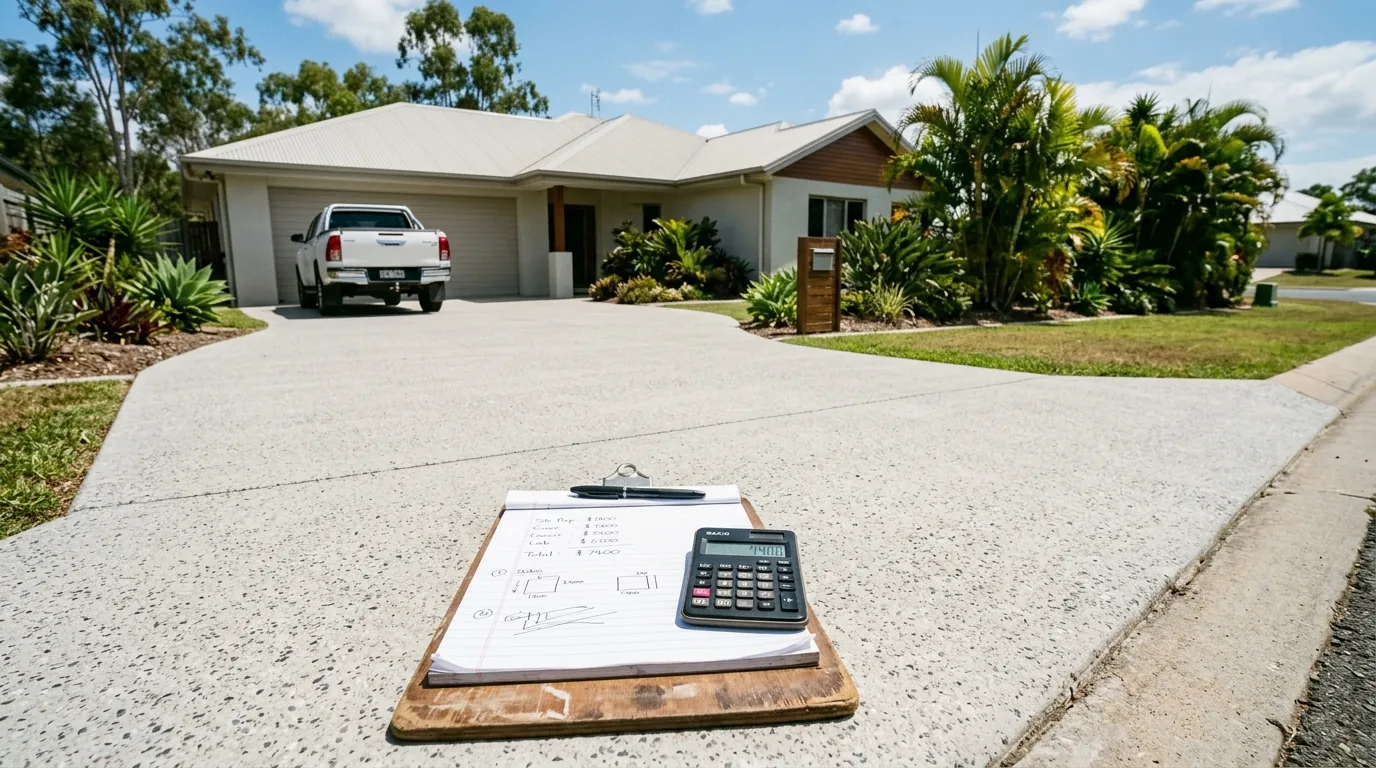
A new concrete driveway is one of the best-value upgrades you can make to a Rockhampton home — but “how much does it cost?” is the first question everyone asks, and the honest answer is it depends. The good news: once you understand what actually drives the price, you can budget with confidence and spot a quote that’s too good to be true.
This guide breaks down what goes into a concrete driveway cost in Rockhampton and across Queensland, finish by finish, so you know what you’re paying for.
The short answer
As a rough guide for Central Queensland, plain concrete driveways typically start in the lower price-per-square-metre range, with decorative finishes costing more:
| Finish | Indicative range (per m²) |
|---|---|
| Plain / broom finish | $ — most affordable |
| Coloured concrete | $$ — mid |
| Exposed aggregate | $$$ — popular premium |
| Stamped / stencil | $$$ — premium |
These are indicative only — a starting point, not a quote. The real figure for your driveway depends on the factors below, which is why we always come out, measure up and give you a written fixed price.
What drives the price of a concrete driveway
1. Size and shape
The biggest single factor is simply how many square metres you’re pouring. A standard single driveway is far cheaper than a long rural driveway in Gracemere or a wide double with a turning bay. Awkward shapes, curves and multiple levels add labour and formwork.
2. The finish you choose
Plain broom finish is the most affordable and the most durable for the dollar. Decorative finishes — exposed aggregate, coloured, stamped or stencil — cost more because of the extra materials, time and skill involved. Exposed aggregate is the most popular premium choice in Rockhampton because it’s tough, non-slip and hides marks.
3. Site preparation and access
This is the part you never see but it makes or breaks the price (and the driveway). Excavation, removing an old slab, building up and compacting road base, and dealing with tricky access or slopes all add to the cost. Skimping here is the number one reason driveways crack and fail early.
4. Thickness and reinforcement
A standard domestic driveway is around 100mm with steel mesh reinforcement. If you’re parking a boat, caravan or heavy vehicle, you’ll want 125–150mm and heavier reinforcement — more concrete and steel, but essential for the load.
5. Drainage and crossovers
If water needs managing, or your crossover (the bit between your boundary and the road) needs to meet Rockhampton Regional Council or Livingstone Shire standards, that’s factored in too.
Why the cheapest quote is rarely the cheapest driveway
It’s tempting to take the lowest number, but a driveway is a 30–40 year investment. A quote that’s well below the others usually means corners are being cut somewhere you can’t see — thinner concrete, less reinforcement, skipped base preparation, or no proper falls for drainage. You save a few hundred dollars now and pay thousands to replace a cracked, pooling slab in a few years.
A fair, detailed written quote that spells out the thickness, reinforcement, prep and finish is worth far more than a cheap verbal number scribbled on the back of a card.
How to get an accurate price for your driveway
The only way to know what your driveway will actually cost is to have a licensed concreter look at the job. At Rockhampton Concreting Co we measure up, assess the site and soil, talk through the finish that suits your home and budget, and give you a clear, itemised written quote — free and with no obligation. The price we quote is the price you pay.
If you’re weighing up finishes, our exposed aggregate and concrete driveways pages walk through the options in detail.
Ready for a real number? Get a free quote and we’ll price your driveway properly.