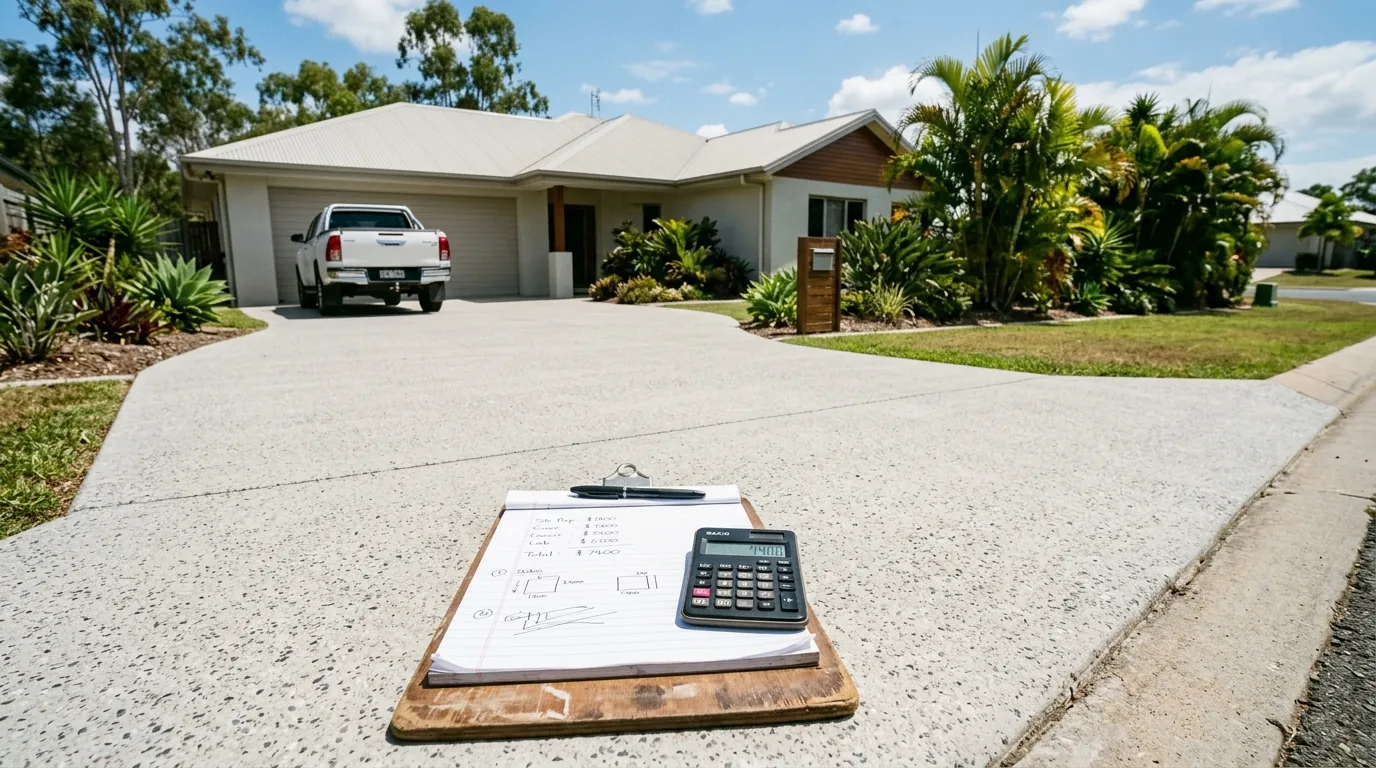
It’s one of the first questions we get once a homeowner starts pricing a new driveway: how thick does the concrete actually need to be? It matters more than most people realise — get it right and the driveway carries decades of cars, trailers and the occasional delivery truck without a crack. Get it too thin and you’ll see cracking, sinking and edge failure within a few years.
Here’s a plain-English guide to concrete driveway thickness for Rockhampton, Gracemere and the Capricorn Coast, and the things that change the number.
The short answer
For a standard residential driveway carrying normal cars and light vehicles, 100mm (4 inches) of concrete over a properly prepared base is the accepted minimum and the most common spec across Central Queensland.
If the driveway will regularly carry heavier loads — a caravan, a boat on a tandem trailer, a work truck, a horse float, or delivery vehicles — you step up to 125–150mm (5–6 inches), often with heavier reinforcement.
For commercial driveways, crossovers and hardstands that see trucks and constant traffic, thicknesses of 150mm and above with engineered reinforcement are standard.
Thickness by use
| Driveway use | Typical thickness |
|---|---|
| Standard cars / light vehicles | 100mm |
| Caravans, boats, work utes, occasional trucks | 125–150mm |
| Commercial, trucks, heavy or constant traffic | 150mm+ (engineered) |
| Council crossover (kerb to boundary) | Per council spec — often 150mm |
Note the last row: the crossover — the section between the kerb and your property boundary — is usually governed by Rockhampton Regional or Livingstone Shire council standards, and often has to be thicker and reinforced to a set spec. We build crossovers to the relevant council requirement so they pass inspection.
Thickness is only half the story — the base matters just as much
A 100mm slab on a poorly prepared base will fail before a 100mm slab on a properly compacted one. Under every good driveway is:
- A compacted sub-base of road base or crusher dust, graded and rolled so the ground doesn’t move under the slab.
- The right falls so water runs off rather than pooling — critical in our wet season.
- Clean, stable ground with soft spots dug out and rebuilt.
Skimping on the base is the number one cause of early cracking, no matter how thick the concrete is. When you read a quote, look for what’s specified under the slab, not just the slab itself.
Reinforcement: mesh and where it sits
Most residential driveways are reinforced with steel mesh (SL72 or similar) set on chairs so it sits in the correct position within the slab — usually the upper third — where it does the most good controlling cracking. Heavier-duty driveways use heavier mesh or bar. Reinforcement doesn’t stop concrete from ever cracking, but it holds any cracks tight and keeps the slab acting as one piece.
Control joints — the other crack-control tool
Concrete shrinks slightly as it cures and moves with big CQ temperature swings. Control joints (the grooves cut or tooled into a driveway) give that movement a planned place to happen, so cracks form neatly in the joint rather than randomly across the surface. Correct joint spacing for the slab thickness is part of doing the job properly.
What happens if a driveway is too thin
We’re sometimes called out to driveways poured too thin or with no proper base — and the symptoms are always the same: cracking that spreads, sections that sink or rock, crumbling edges where cars turn in, and water pooling. At that point resurfacing rarely fixes it; the slab usually has to come out and be redone. It’s far cheaper to pour it correctly once.
The bottom line
For most Rockhampton homes, 100mm over a well-prepared, compacted base with steel mesh and proper joints is the right driveway. Step up to 125–150mm if you’ll be parking anything heavy on it, and always build the crossover to council spec. If you’re not sure what your driveway needs to carry, that’s exactly what we work out on site.
Want it done right the first time? Our concrete driveways in Rockhampton page explains our approach, or get a free quote and we’ll spec the correct thickness for your driveway and budget.