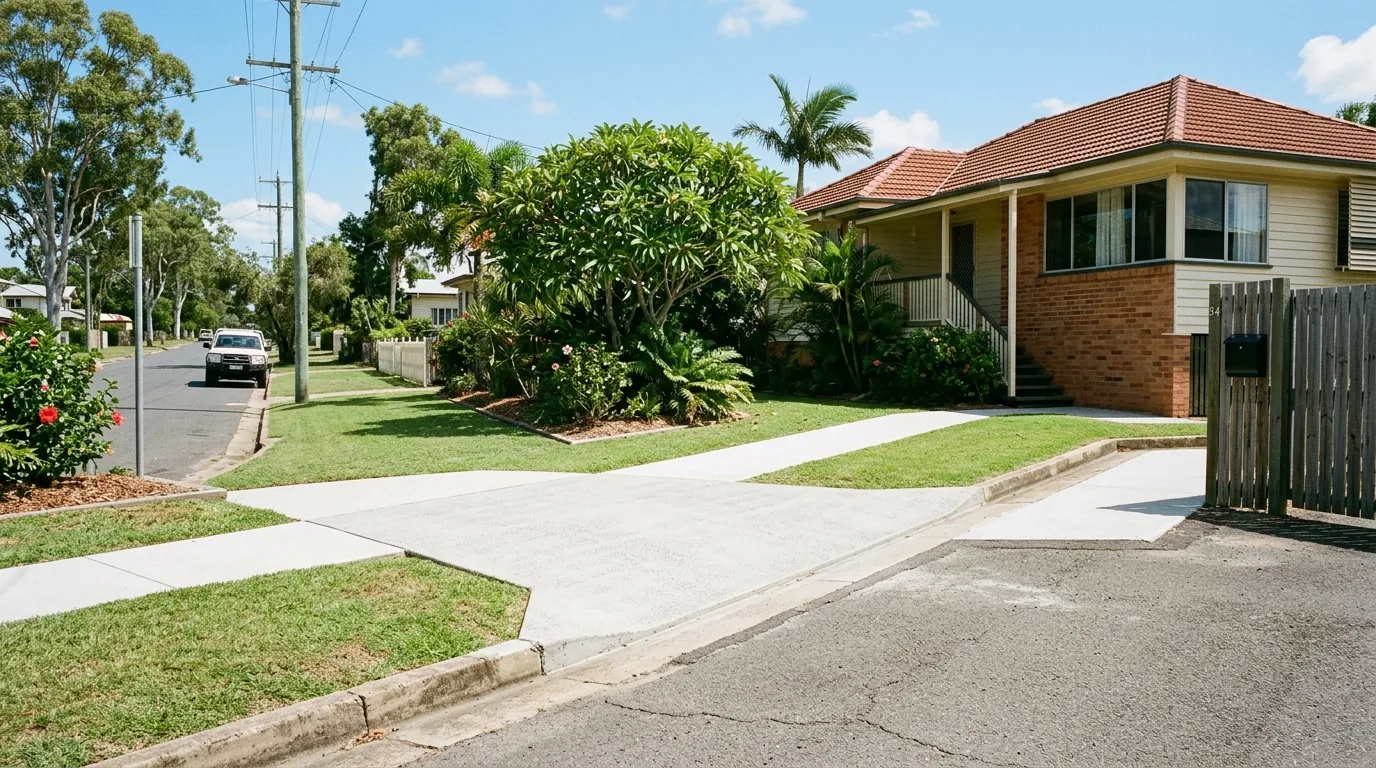
It’s one of the most common questions we get before a job: “Do I need council approval to put in a driveway?” It’s a fair question — nobody wants to pour a slab and then find out it doesn’t meet the rules. The honest answer is it depends on which part of the driveway you mean, so let’s break it down clearly.
This is a general guide for Queensland homeowners. Council rules change and every property is different, so always confirm the current requirements with your own council before you start.
The driveway vs the crossover
The key thing to understand is that a driveway has two parts, and they’re treated very differently:
- The driveway itself — the section on your property, from your garage or carport to the boundary. This is generally your own business and doesn’t usually need council approval, though it may be tied to your building approval if it’s part of a new build.
- The crossover (or vehicle layback) — the section that crosses the council-controlled area between your property boundary and the road, including the kerb and any layback. This part is on council land, and it almost always has to be built to council standards and approved.
So when people ask “do I need council approval for a driveway?”, the part that usually triggers a permit is the crossover.
Why the crossover needs to meet council standards
The crossover is where your driveway meets the public road network, so councils set standards to make sure it’s safe and built properly. They typically care about things like:
- Location and width — so vehicles can enter and exit safely, and it doesn’t clash with stormwater pits, power poles, street trees or sight lines.
- The layback and kerb — how the kerb is cut and laid back so vehicles don’t scrape and water still drains along the gutter.
- Levels, falls and drainage — so water flows where it’s meant to and doesn’t pond or run onto the road.
- Construction standards — thickness, reinforcement and finish that will stand up to vehicle loads.
Get this wrong and you can be asked to rip it out and redo it — an expensive lesson. Doing it to standard the first time is far cheaper.
Rockhampton Regional Council vs Livingstone Shire
Here’s where it pays to know your local area, because the Rockhampton region is split across councils:
- Rockhampton Regional Council covers Rockhampton, Gracemere and surrounds.
- Livingstone Shire Council covers the Capricorn Coast — Yeppoon, Emu Park and the surrounding coastal areas.
Both councils have their own permit processes, standard drawings and fees for vehicle crossovers, and the specifics can differ. If you’re on the coast, you’ll be dealing with Livingstone; in town, it’s Rockhampton Regional. Whichever applies to you, check their current crossover/driveway requirements before booking the job. Our service areas page lists the suburbs we cover across both council areas.
Permits and inspections — how it usually works
While the exact process varies by council, a typical crossover approval looks something like this:
- Apply for a permit to construct (or modify) a vehicle crossover, often with a site plan showing the proposed location.
- Council reviews and approves the location and design against their standards.
- The work is built to the approved drawings and council’s standard details.
- An inspection may be required — sometimes before the pour (formwork/levels) and/or after completion.
Some councils also require the crossover work to be done by an appropriately qualified contractor and may ask for a bond or fee.
Who arranges what?
This is the part homeowners most want clarity on:
- The property owner is generally responsible for the crossover and for the application — it’s your property’s access.
- A good concreter will know the local standards, build the crossover to spec, and can guide you through what’s needed. We’re across the Rockhampton and Livingstone requirements and build crossovers to council standard as part of our concrete driveways work.
- The council is the final authority on what’s approved and inspected.
The smoothest jobs are the ones where the owner and concreter sort out the crossover requirements before the driveway is designed, not after.
Do it right the first time
A driveway is a long-term investment, and the crossover is the one part where cutting corners can come back to bite you — both safety-wise and with the council. The good news is it’s straightforward when you plan ahead: confirm the requirements with Rockhampton Regional or Livingstone Shire, get the permit sorted, and build the crossover to standard.
If you’re planning a new driveway anywhere from Rockhampton to the Capricorn Coast and want a hand navigating the crossover and council side of things, we’re glad to help. Get a free quote and we’ll talk you through what your job needs — done properly, first time.