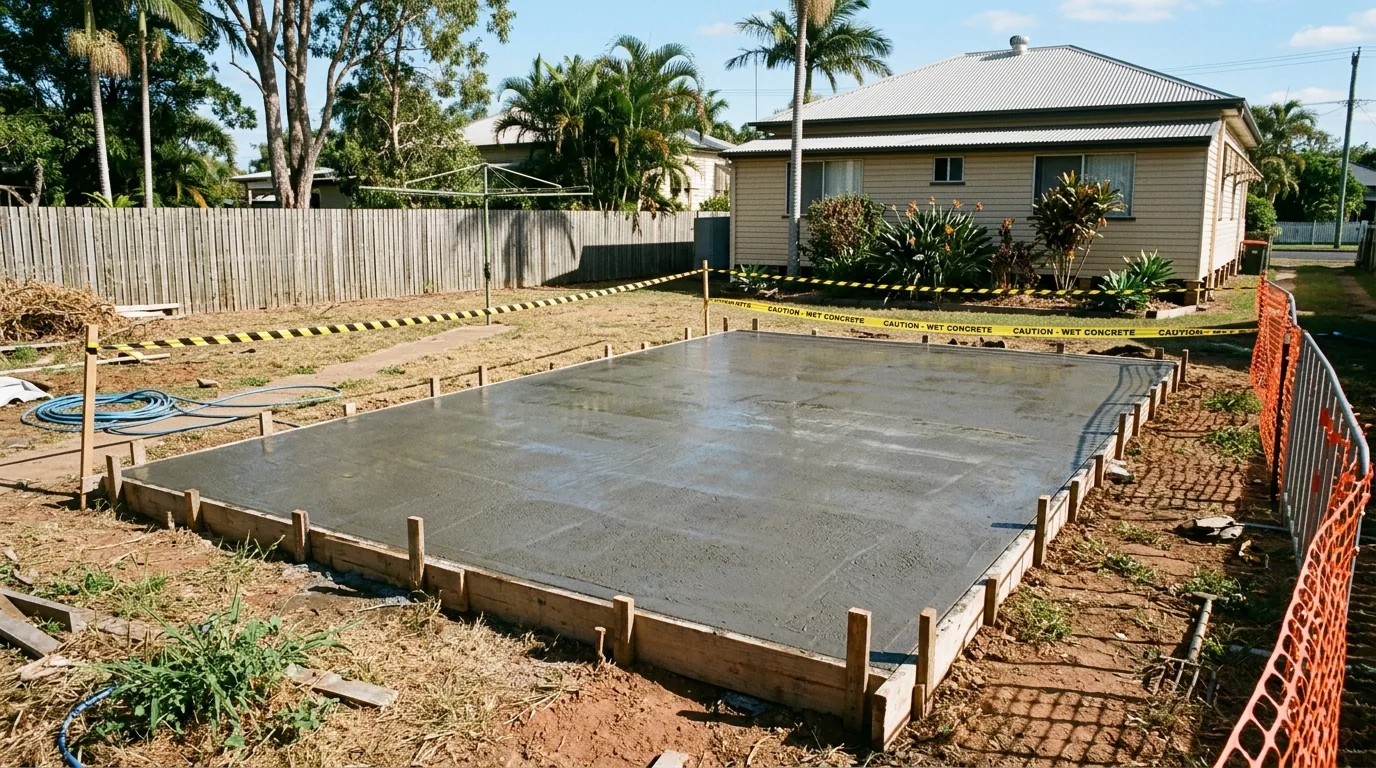
You’ve just had a new driveway, slab or patio poured and it looks finished — so the obvious question is: when can you actually use it? How long before you can walk on it, park the car, or roll the caravan onto it without doing damage?
The short version is that concrete keeps getting stronger for weeks, and rushing it is one of the easiest ways to ruin a perfectly good pour. Here’s a plain-English guide to how concrete cures, the milestones that matter, and why curing is something we take seriously in the Central Queensland heat.
Curing vs drying — they’re not the same
This trips a lot of people up. Concrete doesn’t simply “dry out” like paint. It cures through a chemical reaction called hydration, where the cement and water react and bind everything together. That reaction needs moisture to keep going — which is why, counterintuitively, we want freshly poured concrete to stay damp, not dry out fast.
If concrete dries too quickly — exactly what happens on a hot, windy Rockhampton day — the reaction stalls before the concrete reaches full strength, and you get surface dusting, shrinkage and cracking. Good curing is about controlling moisture, not removing it.
The milestones that matter
Concrete gains strength on a curve: fast at first, then slowing down as it approaches full strength. Here are the points worth knowing:
| Time after pour | What’s happened | What you can do |
|---|---|---|
| 24–48 hours | Initial set, hard to the touch | Light foot traffic, carefully |
| 7 days | Around 70% of strength | Walk freely; drive a light car (with care) |
| 28 days | Considered fully cured | Park heavy vehicles, full normal use |
24–48 hours
The concrete has set hard enough to walk on lightly, but it’s still green and vulnerable. Keep kids, pets, bikes and furniture off it. Edges and corners chip easily at this stage.
7 days
By a week, concrete has typically reached around 70% of its design strength. This is usually the point where you can drive a normal car onto a driveway — gently, no sharp turning. We’ll give you specific timing for your job, because thickness and weather change it.
28 days
The classic benchmark. At 28 days concrete is considered fully cured and at (or very near) its design strength. This is when it’s safe to park heavy vehicles, caravans, boats and trailers, and put the slab into full service.
When can you walk, drive and park heavy?
A simple rule of thumb for a standard domestic pour:
- Walk on it: after 24–48 hours, carefully
- Drive a light car: after about 7 days
- Park heavy loads (caravan, boat, truck): after 28 days
These are guidelines, not guarantees. Cold weather slows curing down; a thicker slab or a heavily reinforced one may need longer. Always go with the timing your concreter gives you for the actual job.
Why curing matters more in CQ heat
Central Queensland throws the toughest conditions at fresh concrete — high temperatures, strong sun and drying winds all pull moisture out of the surface fast. That’s the enemy of a good cure. Concrete poured and left to fend for itself on a 35°C day can lose surface strength and start crazing or cracking within days.
That’s why how a concreter manages curing in our climate is just as important as the mix and the prep. It’s one of the quiet things that separates a slab that lasts 40 years from one that’s flaking inside a couple of summers.
How we manage curing
We don’t just pour and walk away. Depending on the job and the weather, we manage curing by:
- Timing the pour to avoid the worst of the heat where possible
- Keeping the surface moist with curing compounds, wet covers or controlled water
- Protecting fresh concrete from direct sun and wind in the critical first days
- Giving you clear instructions on when it’s safe to walk, drive and load up
Good curing costs us a little extra effort up front and saves you from cracking, dusting and early failure down the track. It’s not an optional extra — it’s part of doing the job properly.
Got a pour coming up?
If you’re planning a new driveway, slab or patio and want it done by a crew that treats curing as seriously as the pour itself, we’re happy to talk it through. We’ll explain exactly how we’ll manage your job in our climate and give you a clear, written quote — free and with no obligation.
Ready to get started? Get a free quote and we’ll look after the details.