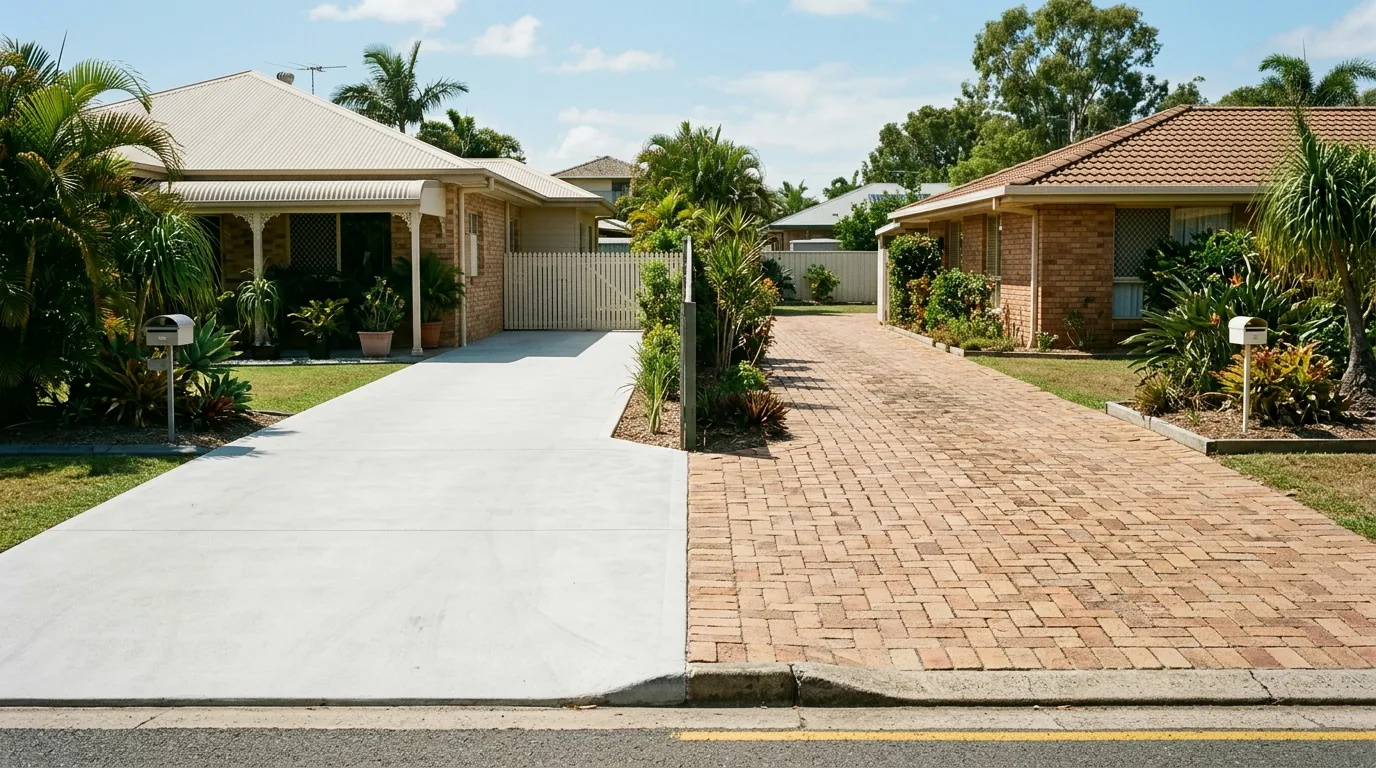
Concrete vs pavers is one of the most common driveway questions we get in Rockhampton, and it’s a fair one — both can look great and last decades. But they behave very differently over time, especially in the Central Queensland climate, and the cheaper option upfront isn’t always the cheaper option over twenty years.
Here’s an honest comparison, including the things paver salespeople tend to gloss over.
The quick verdict
Concrete is usually the better all-round choice for a driveway in CQ: lower lifetime cost, fewer weeds, and less ongoing fuss. Pavers win on certain looks and on ease of repair. Neither is “wrong” — it depends on what you value.
Side-by-side comparison
| Factor | Concrete | Pavers |
|---|---|---|
| Upfront cost | $$ — mid (decorative higher) | $$–$$$ — labour-heavy |
| Longevity | 30–40+ years | Long, but joints need upkeep |
| Weeds in joints | None (solid slab) | Common without maintenance |
| Ant-hills / sand loss | No | Joints can be undermined |
| Maintenance | Low (occasional seal) | Higher (re-sand, weed, level) |
| Repairs | Patch or resurface | Lift and relay individual pavers |
| Look options | Plain, coloured, exposed, stamped | Many shapes and patterns |
| Settling / movement | Rigid, stays put on good base | Can rut or sink over time |
Upfront cost
Plain concrete is typically the most affordable way to get a solid driveway. Decorative concrete (exposed aggregate, coloured or stamped) moves into the same bracket as good pavers. Pavers carry a lot of labour cost because every unit is laid by hand. As always, these are indicative — we measure up and give a free written quote so you’re comparing real numbers.
Longevity and the CQ climate
A properly poured and reinforced concrete slab over a compacted base will sit happily for 30 to 40 years. Our heat and the occasional big wet are no problem for concrete that’s been done right.
Pavers laid over a good base also last a long time — but the joints are the weak point. Heavy CQ downpours can wash sand out of the joints, and over years the surface can rut where car tyres track or sink in spots if the base wasn’t perfect.
Weeds, ant-hills and the joint problem
This is the big one people underestimate. Pavers have hundreds of joints, and in our climate those joints become homes for:
- Weeds — they find any gap and pop through, needing regular spraying or pulling.
- Ants and ant-hills — ants love jointed pavers and can undermine the sand bedding from below.
- Sand loss — heavy rain and pressure-washing strip joint sand, which then needs topping up.
A concrete slab has none of this. It’s one solid, sealed surface — nothing to grow through and nothing for ants to burrow into.
Maintenance
Concrete is close to fit-and-forget: an occasional clean and a reseal every few years. Pavers need ongoing attention — weeding, re-sanding joints, the odd re-level — to stay looking sharp.
Repairs
Here pavers have the edge. If one paver cracks or a section sinks, you can lift and relay just that area. With concrete, a repair means patching, resurfacing or, in a bad case, replacing a section. That said, a well-built slab rarely needs it.
Look
Both can look fantastic. Pavers offer lots of patterns and shapes. But modern decorative concrete has closed the gap — stamped concrete can mimic pavers, brick or natural stone as one seamless, weed-free slab, giving you the paver look without the paver maintenance.
When each one wins
Choose concrete if you want:
- The lowest lifetime cost and least maintenance
- No weeds, ants or joint upkeep
- A long, trouble-free life in the CQ climate
- The paver look without the joints (via stamped concrete)
Choose pavers if you want:
- A very specific paver pattern or heritage look
- The ability to lift and replace individual units easily
- Phased DIY laying over time
For most Rockhampton driveways, we lean toward concrete for the value and the low fuss — see our concrete driveways page for finishes and options.
Get the right driveway for your block
The best decision comes from looking at your actual site — soil, slope, access and how you’ll use it. We pour driveways across Rockhampton, Gracemere, Yeppoon and the Capricorn Coast and we’ll give you a straight recommendation.
Get a free quote and we’ll help you weigh up concrete vs pavers for your place.